What is Leverage in FXPro?
Introduction
Leverage is a trading tool that allows traders to control a larger position than their account balance alone would normally allow.
In simple terms, leverage means borrowing trading capacity from the broker. It can increase potential returns, but it also increases potential losses.
FXPro offers leverage depending on the client’s region, account type, instrument, and regulatory entity. Traders should understand how leverage works before using it.
1. Understanding Leverage
Leverage is usually shown as a ratio, such as 1:100 or 1:500.
For example, with 1:100 leverage, a trader may control a $100 position with $1 of margin.
This can make trading more capital-efficient, but it also increases risk. A small market move can have a larger impact on the account balance.
Leverage should not be viewed only as a way to increase profit potential. It also increases the speed and size of possible losses.
2. Leverage Options at FXPro
FXPro reviews say leverage depends on several factors, including the asset being traded and the regulatory rules that apply to the trader’s account.
Major forex pairs may have higher leverage than more volatile instruments.
CFDs on stocks, commodities, indices, and cryptocurrencies often have lower leverage limits because these markets can carry higher risk or stronger price movement.
Crypto CFDs usually have more conservative leverage because of their volatility.
Before trading, users should check the live leverage limits inside their FXPro account or on the official contract specifications page.
3. How Leverage Works
Here is a simple example.
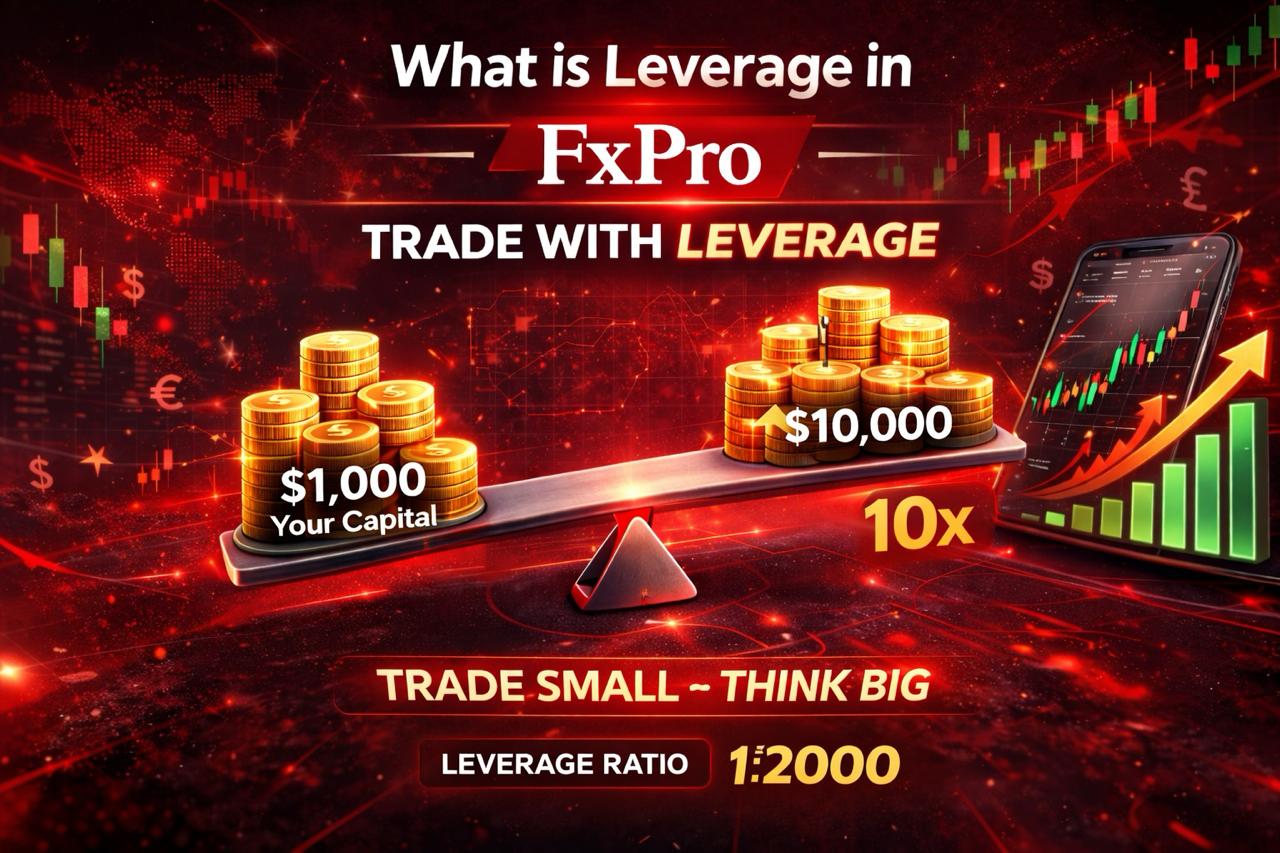
If a trader uses 1:100 leverage and deposits $1,000 as margin, they may control a position worth $100,000.
Without leverage, the trader would need the full $100,000 to control the same position.
This can increase potential gains if the trade moves in the trader’s favor.
However, if the market moves against the position, losses are also magnified. This is why leverage should always be used with careful position sizing and risk management.
4. Risks of Leverage
Leverage can be useful, but it is also risky. If a trade moves in the right direction, leverage can increase the return on the margin used.
If the trade moves in the wrong direction, losses can grow quickly and may reduce the account balance faster than expected.
A margin call may occur if the account equity falls below the required margin level. In some cases, positions may be closed automatically to protect the account from further losses.
Traders should avoid using high leverage without understanding margin, stop loss placement, and position sizing.
5. Leverage Regulation at FXPro
Leverage limits vary by region. In Europe and the UK, retail leverage is usually limited under stricter regulatory rules. Major forex pairs may have lower maximum leverage compared with offshore or international entities.
In other regions, higher leverage may be available depending on the FXPro entity and account type.
This means two traders using FXPro may not have access to the same leverage conditions.
Before opening an account, users should check which FXPro entity serves their country and what leverage limits apply.
6. Setting Leverage at FXPro
FXPro may allow users to select or adjust leverage through their account area, depending on account type and regulatory rules.
Beginners should consider starting with lower leverage while learning how margin and price movement affect their account.
Lower leverage can reduce the chance of large losses from small market movements.
More experienced traders may use higher leverage, but only with a clear risk plan and strict position sizing.
Conclusion
Leverage can increase trading flexibility, but it also increases risk. FXPro offers different leverage conditions depending on region, account type, instrument, and regulation.
Higher leverage may allow traders to control larger positions with less margin, but it can also lead to faster and larger losses.
Before using leverage, traders should understand margin requirements, stop loss placement, position sizing, and the risks of leveraged forex and CFD trading.