Pionex Safety and Legality: Is Pionex Safe and Legal to Use?

Introduction
Pionex is a centralized crypto exchange known for its built-in trading bots. It can be useful for users who want to automate trading strategies, but the two most important questions should come before fees, bot settings, or trading opportunities:
Is Pionex safe?
Is Pionex legal to use where I live?
The direct answer is:
Pionex has security tools, identity checks, and published Proof of Reserves information, but it is not risk-free.
Pionex is not available to users in every country or region.
Being able to open the website does not mean the platform is legally available, regulated, or suitable for you.
Users should verify their country eligibility and complete identity checks before depositing meaningful funds.
This guide explains the key safety and legality issues to consider before using Pionex.
Important: This article is for general information only. It is not legal, tax, financial, or investment advice.
Quick Verdict: Is Pionex Safe and Legal?
Question | Short answer |
|---|---|
Is Pionex safe? | It has security features and published reserve information, but users still face exchange, custody, market, and account-security risks. |
Is Pionex regulated everywhere? | No. Crypto rules differ by country, and Pionex’s own terms restrict users in certain jurisdictions. |
Can I use Pionex without checking my country? | No. Always check the latest restricted-jurisdiction and KYC-support rules first. |
Is Proof of Reserves enough? | No. It can provide useful evidence of asset backing, but it is not the same as a complete, continuous financial audit. |
Is Pionex suitable for long-term storage? | It is generally safer to keep only active trading funds on an exchange and use self-custody for long-term holdings where appropriate. |
What Does “Safe” Mean for a Crypto Exchange?
Many users ask whether an exchange is safe, as if there is only one answer.
In reality, exchange safety has several layers:
Platform security
Can the exchange protect its systems, wallets, and user accounts?Custody risk
Who controls the private keys while funds are held on the exchange?Compliance risk
Could an account be restricted, reviewed, or frozen because of KYC, source-of-funds checks, sanctions rules, or regional restrictions?Market risk
Can the user lose money because the asset price falls or a bot uses poor settings?User-security risk
Can phishing, fake support accounts, weak passwords, or incorrect withdrawals lead to a loss?
Pionex can have security controls and still not remove these risks.
That is why “safe” should not mean “guaranteed.” It should mean that a user understands the platform’s controls, limitations, and risks before sending funds.
Is Pionex a Legitimate Exchange?
Pionex is an operating crypto-trading platform with built-in trading bots, mobile apps, account verification, deposit and withdrawal functions, and public terms of service.
Its published terms identify Marketa Trading Inc. as the Pionex operator for the services covered by those terms. The same terms state that Pionex may use external wallet providers or third-party exchanges to custody or facilitate trading for some user assets.
That matters because users are not dealing with a self-custody wallet.
When crypto is deposited into Pionex, the platform manages the account balance, wallet infrastructure, transaction processing, and withdrawal process. Users do not hold the private keys to the exchange-held assets.
This is normal for centralized exchanges, but it creates an important trade-off:
You gain convenience, easier trading, and built-in automation.
You give up direct control of the private keys while assets remain on the platform.
For that reason, Pionex may be appropriate for active trading funds, but it should not automatically be treated as a long-term storage solution for a large portfolio.
Is Pionex Safe?
Pionex has several safety-related measures, but users should evaluate them realistically.
1. Account Security Tools
Pionex encourages users to protect accounts with two-factor authentication, including authenticator-based verification and SMS verification.
Two-factor authentication adds an extra security step after a password. This can reduce the risk of an account being accessed if a password is leaked.
However, 2FA is not enough on its own.
A user can still lose access or funds if they:
Enter login details on a fake Pionex website.
Share a 2FA code with a scammer.
Install malware on their device.
Reuse the same password across multiple websites.
Give remote access to someone pretending to be customer support.
Send crypto to a fake giveaway or recovery address.
The safest account setup includes:
A unique password created only for Pionex.
An authenticator app rather than relying only on SMS.
A secure email account with its own 2FA.
No shared passwords, recovery codes, or 2FA codes.
Careful verification of every Pionex login page and support channel.
Small test withdrawals before sending a large amount to a new wallet.
Common Pionex Scams to Avoid
Scammers often use the Pionex name to make their offers look trustworthy.
The most common scam patterns include:
Fake Support Accounts
A scammer may contact you through Telegram, X, Discord, email, or direct messages and claim to be Pionex support.
They may say:
Your account is at risk.
Your withdrawal must be verified.
You need to move funds to a “safe wallet.”
You have won a giveaway.
Your account will be frozen unless you act immediately.
Real support should never ask you to send funds to a private wallet address to “verify,” “protect,” or “unlock” your account.
Fake Giveaways and Investment Offers
Scammers may promise doubled crypto, bot profits, liquidity-mining rewards, or special access to a profitable trading strategy.
They may show fake dashboards, fake profit screenshots, or fake testimonials.
Never send crypto to an address because someone promises to return more crypto later.
Fake Websites
A phishing website can look almost identical to the real Pionex platform.
Always check:
The website domain.
Browser security warnings.
The official app publisher before installing a mobile app.
Whether the login page was reached through an official source rather than a message link.
If you believe you entered your password or 2FA code on a fake website, change your password immediately and review account-security settings.
Pionex Proof of Reserves: What It Does and Does Not Prove
Pionex has published Proof of Reserves information and stated that third-party audit reports were signed in January 2023.
Proof of Reserves is designed to provide evidence that an exchange held certain assets relative to user balances at a particular point in time.
This can be useful information. It is better than having no reserve disclosure at all.
However, Proof of Reserves is not the same as a full financial audit.
It does not automatically prove:
That every liability is included
The platform will remain liquid in every market condition.
That there are no loans, obligations, legal claims, or off-balance-sheet risks.
That users will always be able to withdraw immediately, so that the exchange cannot face operational or security problems in the future.
That every asset remains fully backed at every moment after the report date.
A good way to think about Proof of Reserves is:
It can be one positive transparency signal, but it should never be the only reason you trust an exchange.
Users should also consider the platform’s legal terms, account restrictions, security practices, custody model, product risk, and their own withdrawal plan.
Does Pionex Protect User Funds?
Pionex’s terms explain that some assets may be held or facilitated through external wallet providers or third-party exchanges.
This means users should understand that centralized exchange custody can involve more than one operational layer.
The platform may use third parties to help with custody, trading, payment processing, or other services. If a third-party provider has an outage, security issue, compliance problem, or service interruption, users may face delays or limitations.
This does not mean that a problem will happen. It means users should avoid assuming that exchange balances are equal to self-custody.
A practical risk-management approach is:
Keep only the funds needed for active trading on Pionex.
Withdraw unused funds when you no longer need them on the platform.
Use a self-custody wallet for long-term holdings if you understand how to secure recovery phrases and private keys.
Keep records of deposits, trades, and withdrawals.
Avoid leaving large balances in any single exchange account.
Is Pionex Legal? Pionex's legality depends on several things:
Your country of residence.
Your nationality.
Your KYC documents.
Your local crypto laws.
Whether you use spot trading, futures, automated bots, or fiat services.
Whether Pionex accepts users from your jurisdiction.
Whether your activity creates tax-reporting obligations.
A platform can be available online while still being unavailable to users in a specific country.
For example, a crypto exchange may restrict users from a country because of sanctions rules, licensing limits, local regulation, internal risk policy, or payment-provider restrictions.
That is why users should never assume:
“I can access the website, so I am allowed to use every service.”
Pionex Restricted Countries and Regions
Pionex’s published terms list several restricted jurisdictions. At the time of the Pionex review, those terms identified mainland China, Hong Kong, the United States, Singapore, Afghanistan, Cuba, Iran, North Korea, Syria, the United Kingdom, Canada, the Netherlands, Spain, and France as restricted jurisdictions.
Its Help Center also publishes a separate list of countries and regions where phone-number services and KYC verification are unsupported.
These two lists are related but not identical.
That difference is important.
A country may appear in:
The general restricted-jurisdiction list, the phone number and the KYC unsupported list.
A limitation affecting only a specific product.
A restriction caused by a third-party payment provider.
A local law or regulation that changes after the platform updates its terms.
For this reason, do not rely only on an old blog post, social-media comment, or third-party review.
Before opening an account, check:
The latest Pionex Terms of Service.
The official unsupphone number and KYC list.
Whether your country is allowed for the specific service you want.
Whether local rules permit crypto trading or derivatives.
Whether you can complete KYC honestly using your real residence information.
Can You Use a VPN to Access Pionex?
You should not use a VPN, borrowed documents, a false address, or another person’s identity to bypass Pionex restrictions.
This can create serious problems later.
For example, you may be able to create an account, but then face issues when:
Completing KYC.
Depositing through a payment provider.
Requesting a withdrawal.
Responding to a source-of-funds review.
Attempting to recover a compromised account.
Filing a support complaint.
Pionex’s terms allow it to restrict or suspend accounts when it cannot verify information, suspects restricted activity, or believes that there is a compliance risk.
Using false or inconsistent information can make the situation worse.
The safer choice is to use an exchange that officially supports your country and the products you need.
Is Pionex Regulated?
Pionex states in its own disclaimer that it is not licensed in any jurisdiction as a broker, financial advisor, investment advisor, portfolio manager, or tax advisor.
This statement should not be misunderstood.
It does not automatically answer every question about Pionex’s legal structure, local registrations, or product-specific compliance. But it does mean users should not treat Pionex as a regulated investment adviser or assume it provides regulated financial advice.
Before using Pionex, users should understand that:
Crypto regulation varies widely across countries.
Exchange access does not equal investor protection.
Bot tools are not financial advice.
Past bot performance does not guarantee future results.
Leveraged or futures products can be restricted or unsuitable in many jurisdictions.
Local tax rules may apply even when an exchange is based elsewhere.
Users who are uncertain about local legality should consult a qualified legal or tax professional in their country.
Can Pionex Freeze or Restrict an Account?
Like many centralized exchanges, Pionex can restrict accounts under certain conditions.
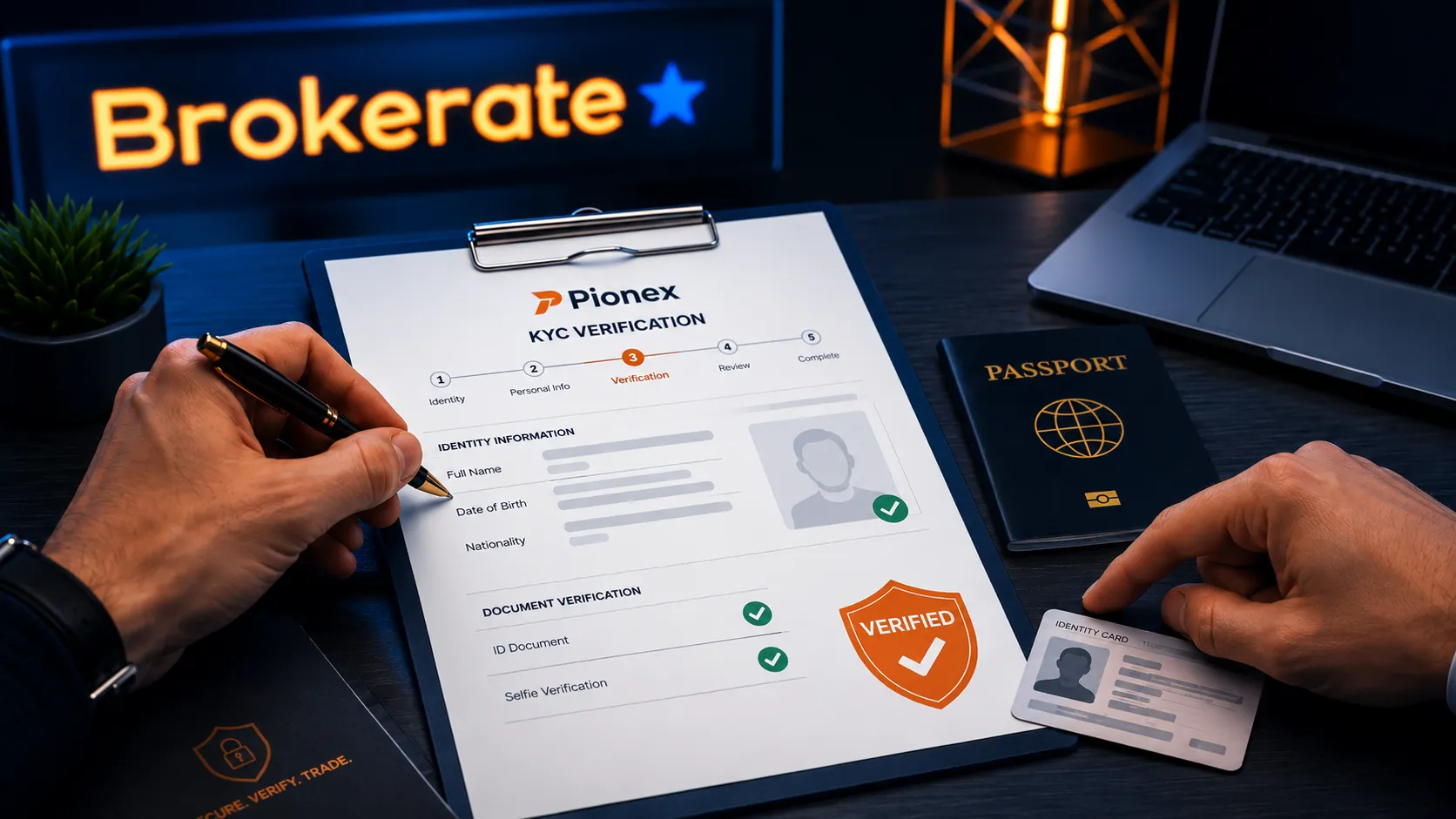
Its terms state that account access, withdrawals, trading, or balances may be limited when the platform cannot verify user information, detects suspected restricted activity, receives a valid legal request, sees signs of possible financial crime, or identifies a higher compliance risk.
This is one reason why users should not wait until they urgently need to withdraw before completing verification.
To reduce the chance of preventable account issues:
Use real and consistent personal information.
Complete KYC before depositing a large amount.
Avoid using a VPN to bypass regional restrictions.
Keep source-of-funds records for large deposits.
Do not accept crypto from suspicious or unknown sources.
Use only bank accounts, cards, and wallets that belong to you.
Respond to legitimate compliance requests promptly and honestly.
Is Pionex Safe for Trading Bots?
A trading bot is not inherently safe or unsafe. It is a tool.
Pionex bots place trades automatically according to settings selected by the user. They do not predict the market, guarantee returns, or remove the risk of loss.
A bot can lose money when:
The chosen asset falls sharply.
A Grid Bot is set in the wrong price range.
Fees consume small profits.
The market trends strongly instead of moving sideways.
Leverage increases losses.
A futures position approaches liquidation.
The user follows a copied strategy without understanding it.
The safest way to start is to use small amounts, avoid leverage, understand the strategy, and test settings before committing meaningful capital.
How to Use Pionex More Safely
There is no way to remove all crypto risk. But you can reduce avoidable risk.
Before Opening an Account
Check whether Pionex supports your country and phone number.
Read the current Terms of Service.
Check whether the product you want is available in your jurisdiction.
Avoid signing up through unofficial referral links or social-media messages.
After Opening an Account
Use a unique password.
Enable authenticator-based 2FA.
Secure your email account.
Complete KYC with accurate documents.
Do not share passwords, recovery codes, or 2FA codes.
Review account activity regularly.
Before Depositing
Start with a small amount.
Confirm the asset and blockchain network.
Never send funds to a support agent, giveaway wallet, or recovery address.
Keep records of the source of your funds.
Before Using a Bot
Understand the strategy.
Avoid copying a bot simply because it shows past profits.
Do not use leverage until you understand liquidation risk.
Decide in advance how much you are willing to lose.
Before Withdrawing
Confirm the receiving wallet and network.
Use a small test withdrawal for a new address.
Check minimum amounts and network fees.
Do not wait until an emergency to test the withdrawal process.
Conclusion: Is Pionex Safe and Legal?
Pionex may be a reasonable option for users who want built-in trading bots and understand centralized exchange risks.
It has account-security guidance, KYC procedures, and published Proof of Reserves material. These are useful signals, but they do not make the platform risk-free.
The main risks to understand are:
Centralized custody.
Country and KYC restrictions.
Account reviews and compliance checks.
Phishing and fake support scams.
Market losses.
Bot-setting mistakes.
Futures and leverage risk.
Withdrawal or payment-provider limitations.
Pionex is not suitable for everyone.
You should not use it if you live in a restricted jurisdiction, cannot complete KYC honestly, need guaranteed bot returns, or want complete control of your private keys.
For eligible users, the safest approach is to use strong account security, keep only active trading funds on the exchange, verify withdrawals with small test transactions, and treat bots as risk-management tools rather than profit machines.