Bybit KYC Guide 2026: Requirements, Verification Levels, Limits & Problems
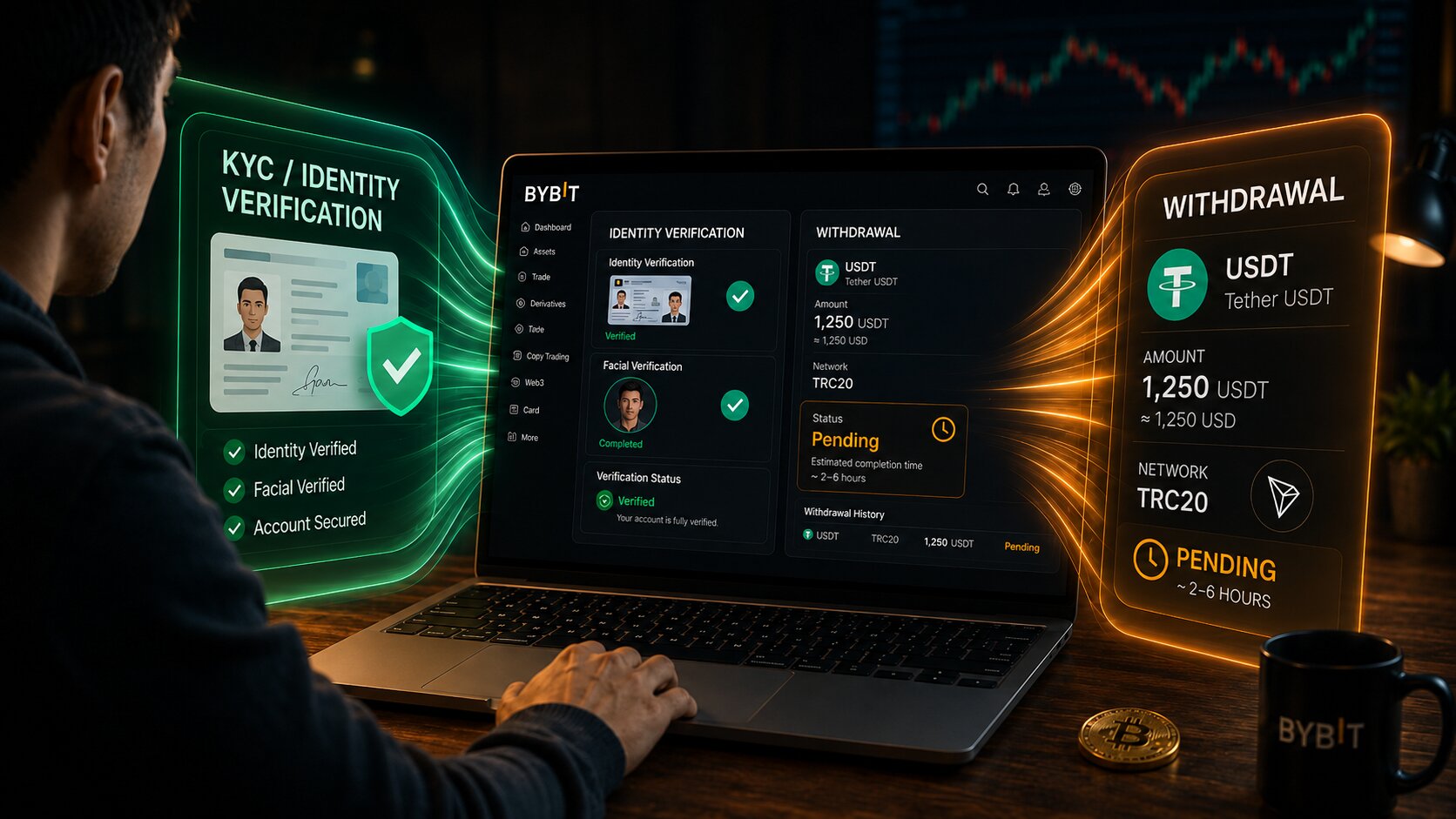
Last updated: August 2026
Does Bybit Require KYC?
Yes. Bybit states that Standard Identity Verification is mandatory for its products and services. Depending on the region or service, users may need to complete additional verification.
For Bybit's global platform, individual verification can include three levels:
Bybit KYC Level | Main Requirement |
|---|---|
Standard | Identity Assessment + Proof of Identity |
Advanced | Proof of Address |
Pro | Enhanced Due Diligence |
Bybit says a normal KYC review may take around 15 minutes, although more complicated cases can take up to 48 hours.
Verification rules can differ between Bybit entities and jurisdictions, so users should always check the requirements shown inside their own account.
Bybit KYC is one of the most important things to understand before using the exchange, especially if you plan to deposit significant funds, use fiat services, trade regularly, or withdraw large amounts.
Bybit currently requires at least Standard Identity Verification to access its products and services. Higher verification levels may be required depending on your country, account activity, product, transaction size, or compliance checks.
This guide reviews how Bybit KYC works in 2026, including verification requirements, accepted documents, KYC levels, verification time, common problems, withdrawal limits, regional differences, and what to do if your Bybit verification is rejected or delayed.
What Is Bybit KYC?
KYC stands for Know Your Customer.
It is an identity-verification process used by cryptocurrency exchanges and other financial platforms to confirm who their customers are.
For Bybit, KYC may involve verifying information such as:
Your legal name
Date of birth
Nationality or country information
Government-issued identity document
Facial recognition
Residential address
Proof of address
Additional financial or compliance information in higher-risk cases
KYC is used for regulatory compliance, fraud prevention, anti-money-laundering controls, account security, and risk management.
From a user's perspective, however, KYC also affects practical account features such as withdrawal limits, fiat services, account recovery, and access to certain products.
Does Bybit Require KYC in 2026?
Yes.
According to Bybit's current Individual KYC FAQ, Identity Verification of at least Standard level is mandatory for all Bybit products and services.
However, users may notice something confusing in Bybit's documentation: some withdrawal-limit tables still include a “No Verification” category.
This should not be interpreted as a guarantee that a new user can freely use Bybit without KYC.
The current access policy says Standard verification is required, while the non-verified withdrawal category may still exist for particular account states, legacy situations, or other operational scenarios.
The safest assumption is therefore simple:
If you plan to use Bybit normally in 2026, expect to complete KYC.
Users should not deposit funds based on the assumption that they will be able to trade or withdraw indefinitely without identity verification.
Bybit KYC Levels Explained
The exact verification structure can differ depending on region, but Bybit's global documentation currently describes Standard, Advanced, and Pro verification.
Bybit Standard Verification
Standard is the basic individual KYC level.
It generally requires:
Identity Assessment
Proof of Identity
Facial verification
Personal information
This is the verification level Bybit currently describes as mandatory for access to its products and services.
For many users, Standard verification will be the first important step after creating an account.
Bybit Advanced Verification
Advanced verification adds Proof of Address.
This means Bybit may ask for documentation showing where you currently live.
Advanced verification can be relevant when users need higher limits or when additional account verification is required.
You normally need to complete Standard verification before proceeding to Advanced verification.
Bybit Pro Verification
Pro verification involves Enhanced Due Diligence, often shortened to EDD.
Enhanced Due Diligence can involve additional questions and supporting documents about the user, their financial activity, or the source of their funds or income.
Bybit's verification guide notes that its EDD process can include a questionnaire and supporting proof-of-income documents.
Pro verification is therefore more detailed than simply uploading an ID.
Completing a higher KYC level also does not guarantee that Bybit will never request additional information later. Exchanges can conduct additional compliance reviews when necessary.
What Documents Are Required for Bybit KYC?
Document requirements depend on the verification level and country.
For Standard KYC, users primarily need a valid Proof of Identity document.
Bybit's individual KYC documentation currently lists supported identity-document categories including:
Passport
Identity card
Residence permit
Driving licence
The document should contain identifiable information such as your:
Photo
Full name
Date of birth
Document number
Issue information
Bybit does not accept every document type. Its global KYC FAQ, for example, states that documents such as student visas, working visas, and travel visas are not accepted as Proof of Identity.
Supported documents can also vary by jurisdiction, so check the document options displayed during the verification process before submitting anything.
Bybit KYC Document Requirements
Even if you submit an accepted type of ID, the verification can still fail if the image or document does not meet the required standards.
Before submitting your identity document, check that:
The document is valid and not expired.
Your full legal name is visible.
Your date of birth is readable.
The document number is visible.
Your photograph is clear.
The entire document is visible.
Important information is not covered.
There is no excessive glare or reflection.
The image is not heavily blurred.
The document has not been digitally altered.
Bybit also states that it does not accept scanned images or electronic copies for individual identity verification where an original physical document is required.
This is one of the reasons a technically valid ID may still be rejected.
Bybit Proof of Address Requirements
Advanced KYC may require Proof of Address.
Bybit's current global documentation lists examples such as:
Utility bills
Official bank statements
Government-issued residential proof
Internet, cable TV, or home telephone bills
Tax documents
Council tax bills
Government-issued certificates of residence
Certain identity documents showing your full residential address
Eligible tenancy or lease agreements
For most Proof of Address documents, Bybit requires the document to be dated within the previous three months.
The document should clearly show your:
Full name
Residential address
Relevant issuing organization
Document date
Examples of documents that may not be accepted include mobile phone statements, insurance documents, medical bills, bank transaction slips, referral letters, handwritten receipts, and some other unsupported document categories.
Do not assume a document will be accepted simply because another exchange accepted it. Always check the current requirements displayed by Bybit for your country.
How to Complete Bybit KYC: Step by Step
The interface may change over time, but the basic Bybit KYC process on the website generally works as follows.
Step 1: Log In to Bybit
Sign in to your Bybit account.
Avoid completing verification through links sent by unknown third parties. Access the verification page from the official Bybit website or app.
Step 2: Open Your Account Settings
Click your profile icon and open your account or identity-verification section.
Look for Identity Verification or the option to complete verification.
Step 3: Select Your Country or Region
Choose your correct country or region when requested.
This information matters because verification requirements and service availability can vary between jurisdictions.
Do not enter false residence or location information to bypass restrictions.
Step 4: Select Your Identity Document
Choose the country or region that issued your document and select the supported document type.
The available choices can differ by jurisdiction.
Step 5: Submit Your Identity Document
Follow the instructions to capture or submit your identity document.
Make sure:
The document is clearly visible.
All required edges are shown.
There is no glare.
The image is not blurry.
The information matches your account details.
Step 6: Complete Facial Verification
Bybit may require facial recognition to confirm that the person completing verification matches the identity document.
Use good lighting and keep your face centered during the process.
Step 7: Complete Any Identity Assessment
Depending on your account and jurisdiction, Bybit may ask for additional personal or compliance information.
Answer accurately and consistently.
Step 8: Submit the Verification
Review your information before submission.
Incorrect names, dates, countries, or document details can create delays or rejection.
Step 9: Wait for the Result
Bybit states that individual KYC generally takes around 15 minutes, but more complex verification can take up to 48 hours.
If your verification remains unresolved for longer than 48 hours, Bybit recommends contacting its Customer Support.
How Long Does Bybit KYC Take?
For many users, Bybit verification can be completed quickly.
Bybit currently says the process generally takes approximately:
Around 15 minutes
However, verification can take:
Up to 48 hours
when additional checks are necessary.
A longer processing time does not automatically mean the KYC has failed.
Possible reasons for a longer review include:
Document-quality problems
Information mismatch
Facial-verification problems
Regional compliance requirements
Manual review
Duplicate identity information
Additional risk checks
High verification volume
Enhanced Due Diligence
If the review exceeds 48 hours, check your account notifications and registered email before contacting support.
Why Is My Bybit KYC Pending?
A pending Bybit KYC application usually means the verification has not yet reached a final decision.
Possible reasons include:
Manual Review
Some applications may require additional human review rather than immediate automated approval.
Document Problems
A blurry, cropped, reflective, damaged, or difficult-to-read document can slow verification.
Information Mismatch
Your name, birth date, nationality, residence, or other information may not match the submitted document.
Additional Compliance Checks
Some users or transactions may require additional verification depending on jurisdiction or risk controls.
Proof of Address Review
Advanced verification can take longer if Bybit needs to validate an address document.
If the KYC remains pending beyond Bybit's stated normal processing window, use the official support process rather than repeatedly creating new verification attempts.
Why Did My Bybit KYC Verification Fail?
Bybit lists several common reasons why identity verification may be unsuccessful.
Problem | Possible Reason | What to Check |
|---|---|---|
ID rejected | Invalid or unsupported document | Use a currently supported government ID |
Document cannot be detected | Blurry, cropped, reflective, or incomplete image | Retake the document clearly |
Facial verification failed | Face not centered or poor camera conditions | Retry with good lighting |
Duplicate identity | Same identity already verified on another account | Check whether you previously verified another Bybit account |
Scan rejected | Screenshot or scanned document submitted | Use the original supported document |
Information mismatch | Account details differ from ID | Check legal name and personal details |
Address rejected | Old or unsupported Proof of Address | Submit a current accepted document |
Country restriction | User falls under a restricted jurisdiction | Check current Bybit service availability |
Age restriction | User does not meet eligibility requirements | Review Bybit's current Terms of Service |
Bybit generally allows only one account per person to process individual KYC verification, which can cause problems if the same identity has already been used elsewhere on the platform.
How to Fix Bybit KYC Verification Problems
If your Bybit KYC is rejected, do not immediately keep resubmitting the same information.
First,t identify the rejection reason.
Then check the following.
Check Your Legal Name
Your name should match your identity document.
Even differences in spelling, missing names, extra characters, or name order can create verification problems.
Use a Clear Original Document
Avoid:
Screenshots
Photocopies
Edited images
Cropped IDs
Reflective images
Blurry photos
Check the Document Expiry Date
An expired document may not be accepted.
Check Your Proof of Address Date
For documents where the three-month rule applies, make sure the document is recent enough.
Improve Facial Recognition Conditions
Use:
Good lighting
A clear camera
A neutral background
An unobstructed view of your face
Check Whether Your Identity Was Used Before
Bybit generally allows one individual KYC verification per person.
If you previously verified a different account, you may need to use Bybit's identity-transfer or account-support process.
Check Country Restrictions
A technically correct document will not solve an eligibility problem if Bybit does not offer the relevant service in your jurisdiction.
Can You Change Your Bybit KYC Information?
In certain circumstances, yes.
Bybit provides tools that may allow eligible verified users to update Proof of Identity or Proof of Address information.
This can be useful when:
Your ID expires.
You receive a new identity document.
Your address changes.
Your verified name contains an error.
Your personal information needs updating.
Eligibility restrictions can apply, and users with suspended, restricted, subaccounts, or pending KYC changes may not always be able to update information immediately.
Do not create a second account simply to solve a KYC-information problem without first checking Bybit's rules.
Can You Have Multiple KYC-Verified Bybit Accounts?
Generally, no.
Bybit states that one user can only use one account to process KYC verification.
KYC verification is also performed on the main account rather than separately on individual subaccounts.
If your identity is already associated with another account, you may need to transfer the verification or contact support rather than attempting to verify the same identity repeatedly.
This is also one of the common causes of Bybit KYC failure.
Bybit KYC Withdrawal Limits
KYC level can significantly affect crypto withdrawal limits.
For non-VIP users, Bybit's current global documentation lists the following general limits:
Verification Status | Daily Crypto Withdrawal Limit |
|---|---|
No Verification category | Up to 20,000 USDT equivalent |
Standard Verification | Up to 1,000,000 USDT equivalent |
Advanced/Pro Verification | Up to 2,000,000 USDT equivalent |
The unverified category also has a monthly limit in Bybit's withdrawal documentation, while users who have completed identity verification generally do not have the same monthly cap.
However, remember the important distinction:
Bybit currently states that Standard Identity Verification is mandatory for its products and services.
Therefore, the existence of a technical “No Verification” limit should not be treated as confirmation that users can normally operate a new account without KYC.
Withdrawal limits can also depend on:
VIP level
Account status
KYC level
Internal risk controls
Asset
Product
Jurisdiction
Compliance review
Higher VIP tiers can have significantly larger withdrawal limits.
Bybit states that its daily crypto withdrawal limits reset at 00:00 UTC, and token withdrawal limits are calculated using their USDT-equivalent value.
Always check the limit shown inside your own account before making a large withdrawal.
Does KYC Guarantee a Bybit Withdrawal Will Be Approved?
No.
Completing KYC does not guarantee that every withdrawal will be processed immediately.
An exchange may still perform security or compliance reviews.
A withdrawal can be affected by:
Account security changes
Unusual login activity
AML checks
Risk-control reviews
Source-of-funds questions
Withdrawal-address changes
Blockchain congestion
Asset availability
Account restrictions
Open positions
Funds locked in products
Incorrect network selection
Higher KYC verification can increase limits and provide access to services, but it does not remove all risk-control procedures.
Why Can Bybit Withdrawals Be Delayed?
KYC is only one possible reason for a delayed withdrawal.
Other common causes include:
Recent password changes
Email or phone changes
Resetting two-factor authentication
Security settings being changed
A new withdrawal address
Compliance checks
Suspicious account activity
Network congestion
Incorrect blockchain network
Insufficient available balance
Funds being held in another internal account
Funds being used as margin
Assets locked in Earn products
Open orders
If a withdrawal is delayed, identify whether the problem is happening before the transaction is sent to the blockchain or after an on-chain transaction has already been created.
Those are different problems and require different troubleshooting.
Total Balance vs Withdrawable Balance
Seeing crypto in your Bybit balance does not always mean the full amount is immediately withdrawable.
Funds may be:
Used as margin
Reserved for open orders
Held in Earn products
Awaiting settlement
Located in another Bybit account section
Temporarily restricted
Bybit's on-chain withdrawal documentation states that withdrawals are made through the Funding Account, so users may need to transfer funds internally before submitting the withdrawal.
Always check the actual available or withdrawable balance rather than only looking at the total account value.
Bybit KYC and Restricted Countries
KYC is also connected to geographic eligibility.
Bybit does not provide its services in every jurisdiction and maintains a list of excluded jurisdictions.
These rules can change, which means an old list from a blog, forum, social-media post, or YouTube video may no longer be accurate.
Before registering or depositing:
Check Bybit's current restricted-jurisdiction policy.
Confirm which Bybit entity serves your country.
Check whether specific products are restricted.
Check whether fiat services have separate restrictions.
Confirm that your identity documents are eligible.
Do not use fake documents, false residence information, or false location information to bypass restrictions.
Bybit explicitly warns that false representations about location or residence can result in account action.
Bybit Global vs Bybit EU KYC
Users in Europe should pay particular attention to which Bybit platform they are using.
Bybit Global and Bybit EU do not necessarily have identical KYC processes.
Bybit EU states that users in the European Economic Area (EEA) must complete Standard Verification to access its products and services.
Its verification process can include additional steps depending on the user's circumstances, such as:
Proof of Identity
Video verification
Bank verification
Profile information
Enhanced Due Diligence
Proof of Address
Advanced Verification may also affect certain fiat limits.
This is why users should not rely on a tutorial made for another Bybit region.
If your account is served by Bybit EU, follow the instructions and limits displayed specifically for that platform.
Is Bybit KYC Safe?
Submitting KYC to any centralized exchange requires sharing sensitive personal information, so users should understand that identity verification always introduces privacy and data-security considerations.
Bybit states that KYC information is encrypted and protected and that identity-verification information is used for verification rather than marketing purposes.
However, users should still practice basic security.
Complete KYC Only Through Official Bybit Channels
Do not send your passport or identity documents to strangers through:
Telegram
WhatsApp
Discord
Social media
Unverified email addresses
Enable Account Security
Use:
Strong unique passwords
Two-factor authentication
Anti-phishing protection
Withdrawal-address controls where appropriate
Watch for Fake KYC Messages
Scammers may impersonate exchanges and claim that your KYC is expiring, rejected, or urgently needs updating.
Instead of clicking a message link, open Bybit directly and check your account.
How to Reduce Bybit KYC and Withdrawal Problems
A few steps can prevent many problems before they happen.
Complete KYC before depositing a large amount.
Make sure your legal information matches your ID.
Check whether Bybit supports your jurisdiction.
Use current and accepted documents.
Complete Advanced verification early if you expect to need it.
Enable two-factor authentication.
Avoid unnecessary security changes immediately before a withdrawal.
Check your withdrawal limit before moving large amounts.
Use the correct blockchain network.
Make a small test withdrawal before sending a large amount.
Keep records of deposits, trades, and withdrawals.
Check whether assets are actually available in your Funding Account.
Respond accurately if Bybit requests additional compliance information.
Avoid using an exchange as permanent long-term crypto storage when self-custody is appropriate for your situation.
The important idea is to test the exit process before depending heavily on an exchange.
Being able to deposit and trade successfully does not automatically prove that every future withdrawal will be instant or unrestricted.